

A Manifesto for the Global South
The year is 2050.
One in four people on Earth is African. The economic pulse of the world runs through Jakarta, Dhaka, Delhi and Lagos!
But we are facing a systemic contradiction: We are training the architects of the future in buildings designed for the past.
Across the Global South, schools remain Climate Passengers — heat-vulnerable, energy-fragile, and disconnected from industrial transformation.
If we are to survive and thrive, schools must become Active Climate Resilience Hubs.
⚡ Stop Teaching “Awareness.” Start Teaching Sovereignty.
Climate education has been soft for too long.
Recycling drives. Symbolic tree planting. Sustainability posters.
Simply having awareness does not mean having climate sovereignty.
If the Global South is to industrialize without self-destructing, students must master Energy Realism from ‘NOW’.
We must move from “saving the planet” to engineering the transition.
Energy literacy is not just a STEM subject.
It is an economic leverage. It is digital competitiveness. It is national security.
A future-ready curriculum must prioritize:
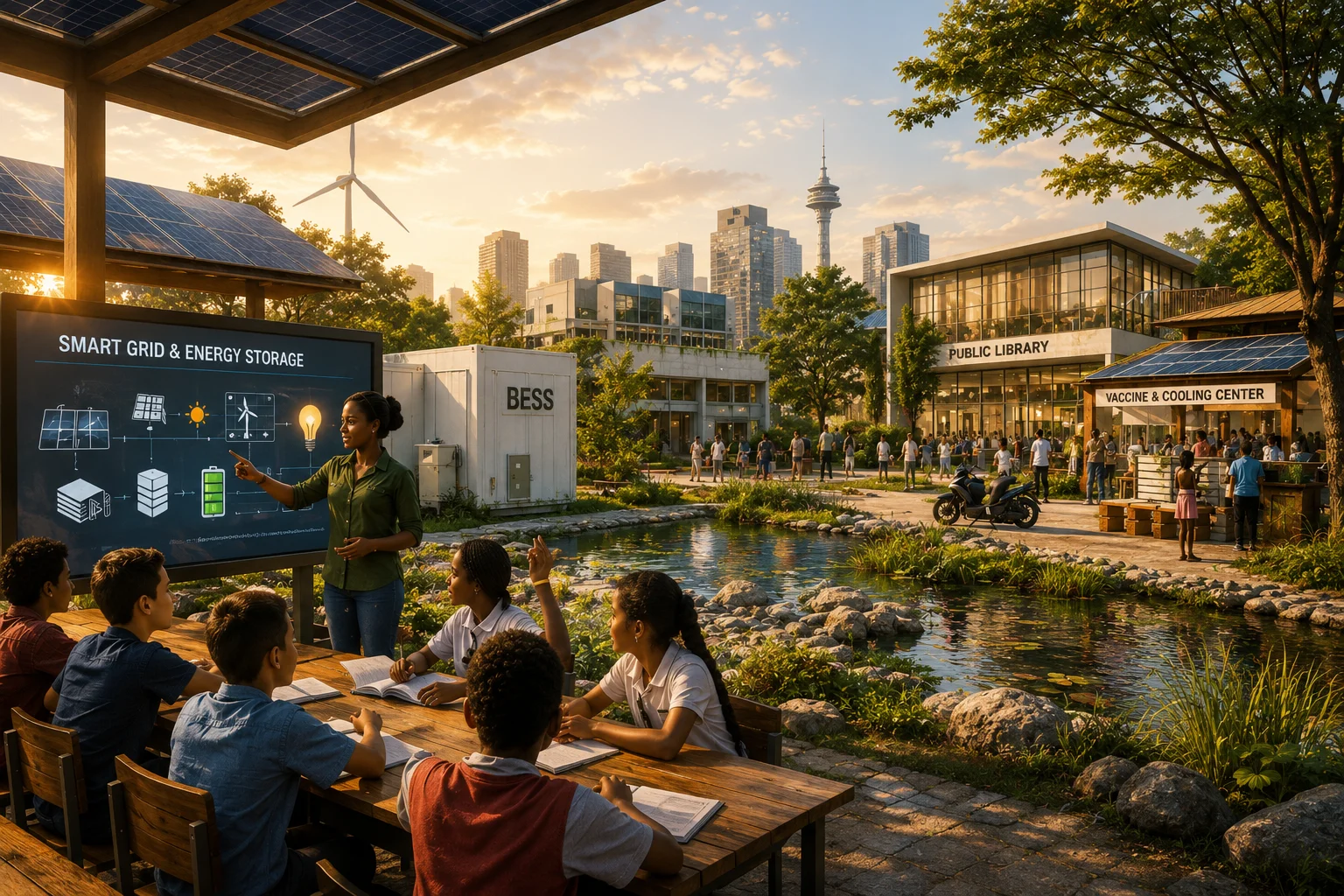
• Grid Intelligence — decentralized smart grids, microgrids, and utility-scale battery storage (BESS)
• Digital Infrastructure Literacy — understanding how data centers, connectivity, and power reliability drive modern economies
• Systems Thinking — regulatory and financial frameworks that convert sunlight into stable industrial power
Industrial growth follows energy reliability. Digital sovereignty follows energy literacy.
🏗️ The Three Pillars: Turning Infrastructure into Action
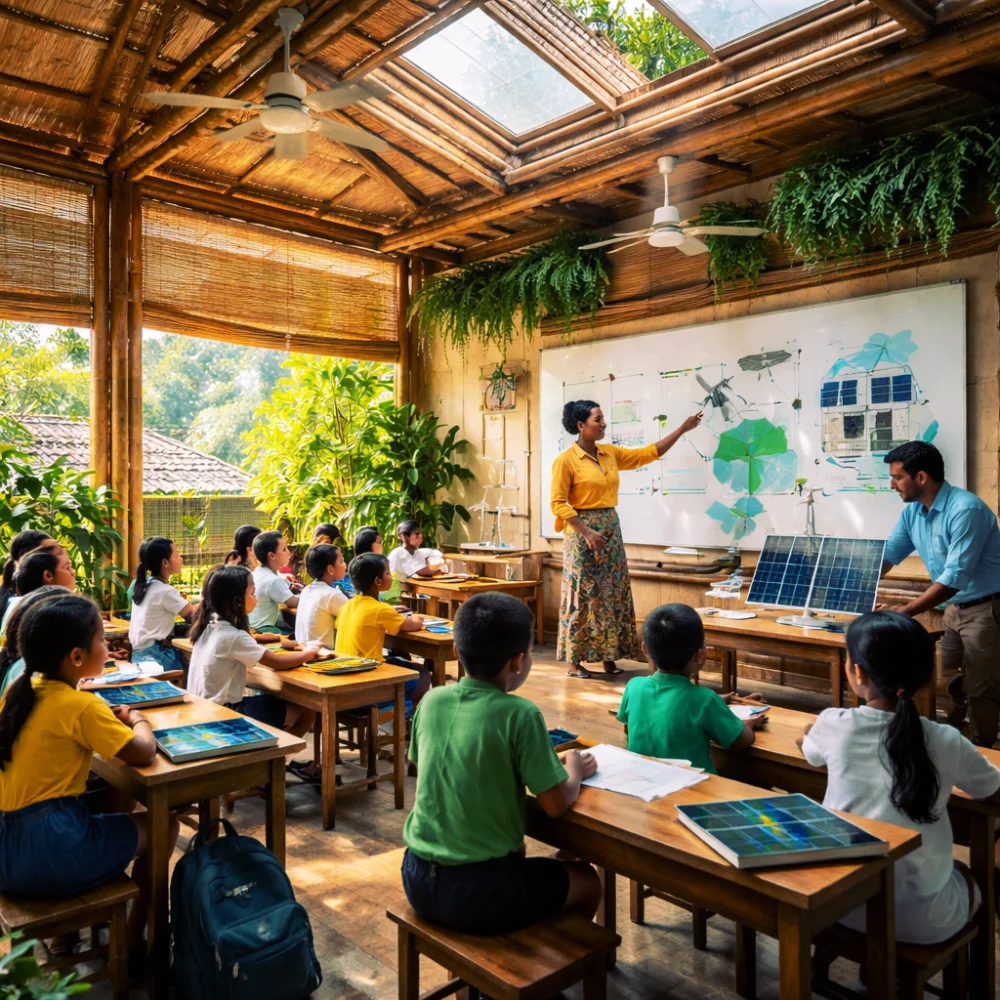
1️⃣ Schools as Community Power Anchors
With over 600 million people in sub-Saharan Africa lacking reliable electricity, a school cannot simply be a building. It must be a microgrid node.
Imagine a school in rural Ghana:
By day, its solar roof powers digital labs and a public library. By night, it becomes a community lifeline. Local vendors charge electric motorbikes for a micro-fee. Farmers store crops in solar-powered refrigeration. The local clinic draws from the school’s battery backup during outages.
Impact: The school shifts from cost center to utility provider — stabilizing the local economy.
2️⃣ Circular Economies as Micro-Enterprises
Education must extend beyond the classroom and into the laboratory of life.
In Lagos, the “Recycle Pay” initiative allows parents to exchange recyclable PET bottles for tuition. At Green School Bali, students build with bamboo and operate biofuel buses powered by used cooking oil.
This is not environmental symbolism. This is resource economics in action. Students graduate seeing waste as raw material. They see supply chains where others see garbage.
Impact: They don’t just consume the future — they design it.
3️⃣ The Sponge School: Nature as Adaptation Infrastructure
Extreme heat is the silent thief of learning. Concrete schoolyards in Dhaka or Jakarta often become heat islands — several degrees hotter than surrounding areas.
Borrowing from the “Sponge City” model, schools can integrate:
• Native tree canopies for passive cooling
• Permeable green courtyards
• Rain gardens that absorb monsoon runoff
Impact: When floods hit, classrooms stay dry. When temperatures spike, learning continues. This is not landscaping. It is core adaptation infrastructure.
🌐 SDG Alignment: Education as Climate Infrastructure
Transforming schools into resilience hubs directly advances:
- SDG 4 (Quality Education): Protects learning continuity and builds technical capacity.
- SDG 7 (Affordable and Clean Energy): Expands decentralized clean power access.
- SDG 9 (Industry, Innovation and Infrastructure): Develops future engineers and industrial planners.
- SDG 11 (Sustainable Cities and Communities): Positions schools as community resilience anchors.
- SDG 13 (Climate Action): Integrates mitigation and adaptation into core infrastructure.
📉 The Policy Imperative
We can no longer be preparing students just to participate in the global economy. We have to prepare them to in advance to redesign it.
Policy makers must recognize three hard truths:
• School infrastructure is a core climate infrastructure.
• Energy curriculum must be integrated within the education curricula.
• Youth training in every vulnerable region must be a national resilience strategy.
The infrastructure of the future is not only steel, lithium, or silicon. It is systems literacy. It is energy fluency. It is curriculum re-design. And the frontline should be the classroom.
📚 Credibility & Data (The “Deep Dive”)
- Demographics: UN World Population Prospects (2022).
- Energy Gap: IEA Africa Energy Outlook (2022) – Africa has 60% of solar resources but 1% of capacity.
- Nuclear Path: IAEA Ghana/Indonesia Nuclear Roadmap Assessments.
- Education Risk: UNICEF/UNESCO Climate & Education Disruption Reports.
Demography, energy, and education are already converging. The only question is whether we align them intentionally or not.
Final Thought
Are we building schools that produce Climate Victims — or Climate Architects? The Global South will define the next industrial era. And the decision must begin in the classroom as soon as possible without any further delay..