

There is a phrase in Islamic environmental ethics that I keep returning to: khalifah/ stewardship. The idea that we hold this Earth in trust, that what we extract from it, we are responsible for returning.
For decades, the construction industry has taken without returning. Cement alone accounts for roughly 8% of global CO₂ emissions, making it one of the largest industrial emitters globally (IEA, 2023; UNEP, 2024). Concrete is the most widely used human-made material in existence. We have built our cities on a carbon debt.
But something is shifting.
A new generation of innovations is beginning to treat CO₂ not as waste, but as a material input. To understand this shift, we must look not only at what these innovations do, but where in the material lifecycle they intervene.
The Technologies and Materials: A Lifecycle Perspective
🔹 Production Stage: Dissolved CO₂ Injection
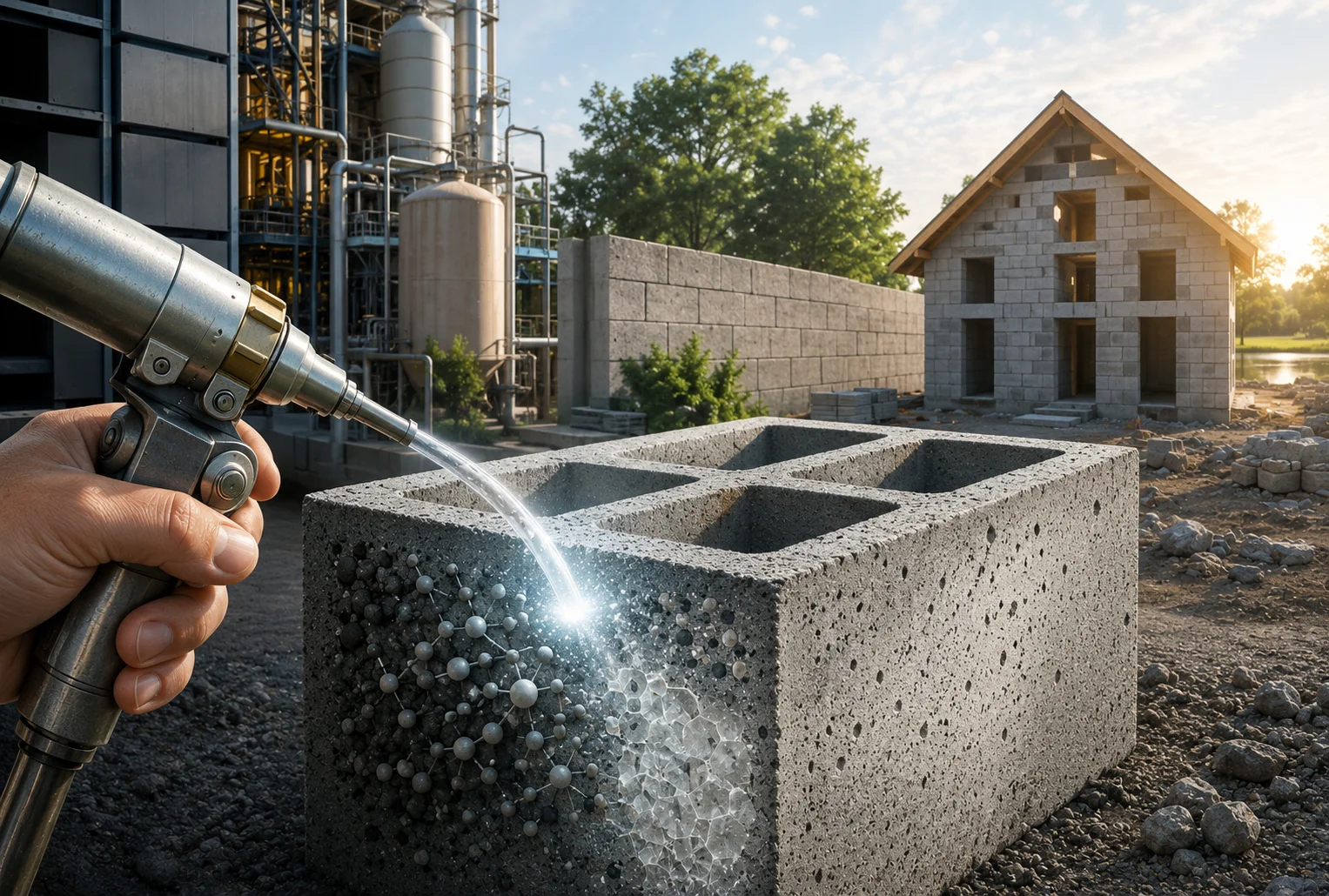
At the earliest stage of material production, CO₂ can be introduced in liquid or dissolved form into manufacturing systems, acting as a controlled delivery mechanism for integrating carbon into concrete, bricks, and blocks during formation itself.
Unlike downstream approaches, this method embeds carbon directly into the material matrix before curing begins, positioning it as a process-level innovation in construction manufacturing systems.
🔹 Curing Stage: CO₂ Curing Technology
In precast concrete facilities, CO₂ is injected during curing. It reacts with calcium compounds to form stable calcium carbonate, thus locking carbon into the material while improving strength and reducing curing time.
This technology is already deployed at scale. However, lifecycle assessments show mixed results. A 2024 Nature Communications study found that in certain process configurations, the emissions associated with CO₂ capture, transport, and additional material requirements can offset, or even reverse the climate benefit (Habert et al., 2024).
This is not a reason to abandon the technology. It is a design signal. For CO₂ curing to deliver genuine climate value, clean energy integration is now essential, not just aspirational. Sourcing CO₂ from high-concentration industrial streams, rather than energy-intensive direct air capture, further reduces the supply chain footprint and improves net efficiency. The technology works. The conditions under which it works need to be built deliberately into procurement, policy, and project design.
🔹 Material Stage: Bio-Foamed Concrete Bricks (B-FCB)
These materials are engineered with porous internal structures that allow CO₂ to diffuse and react over time. This ongoing interaction gradually densifies the material, improving durability while storing carbon continuously.
Unlike process-based approaches, B-FCB represents a product-level innovation; a material designed to store carbon throughout its entire lifecycle, not just at the point of manufacture.
🔹 Biological Stage: Algae-Based Bio-Materials
At the frontier of innovation, microalgae and cyanobacteria absorb CO₂ through photosynthesis and convert it into mineral structures.
Companies like Prometheus Materials and institutions including ETH Zurich and Fraunhofer Institute are developing bio-based bricks and living materials that can significantly reduce or potentially reverse carbon emissions during production (Dranseike et al., 2025). In June 2025, ETH Zurich published research in Nature Communications on a 3D-printable living material that hardens over time as embedded cyanobacteria store carbon in both biomass and mineral form.
These are not theoretical concepts. They are moving into pilot projects and architectural applications, and the question is no longer can buildings store carbon. It is who gets to build them, and who benefits.
Why the Global South Cannot Be an Afterthought
The world’s building stock is projected to double by 2060, with the majority of new construction occurring in the Global South (UNEP, 2024). These regions are not just markets, they are key decision points for the future of global emissions.
China is scaling carbon mineralization technologies within cement and industrial materials, supported by strong policy alignment with carbon neutrality goals.
India is integrating low-carbon materials into large-scale housing programs. Its green building materials market reached USD 13.86 billion in 2024, growing at over 11% annually (IBEF, 2025). The government’s PMAY-U affordable housing scheme now mandates low-carbon materials like fly-ash bricks, autoclaved aerated concrete, in public housing, avoiding an estimated 9 million tonnes of CO₂ by end of 2024 alone. India ranked third globally for LEED certifications in 2024, with 370 projects certified.
Bangladesh, also one of the world’s most climate-vulnerable nations recently approved its Building Energy Efficiency and Environment Rating (BEEER) system in March 2024 and has developed a national Climate Action Roadmap for Buildings and Construction through 2050, in partnership with UNOPS and GlobalABC. In a country where flooding, cyclones, and heat stress are intensifying year by year, the materials buildings are made from are not just a climate question, they are a survival question.
Yet a critical tension remains. Many of the most advanced technologies in this space are being developed in the Global North, while the Global South will bear the greatest burden of both construction demand and climate risk. This is not just a technical challenge. It is a governance challenge, and civil society has a direct role in shaping the answer.
Alignment with Global Goals — and Honest Gaps
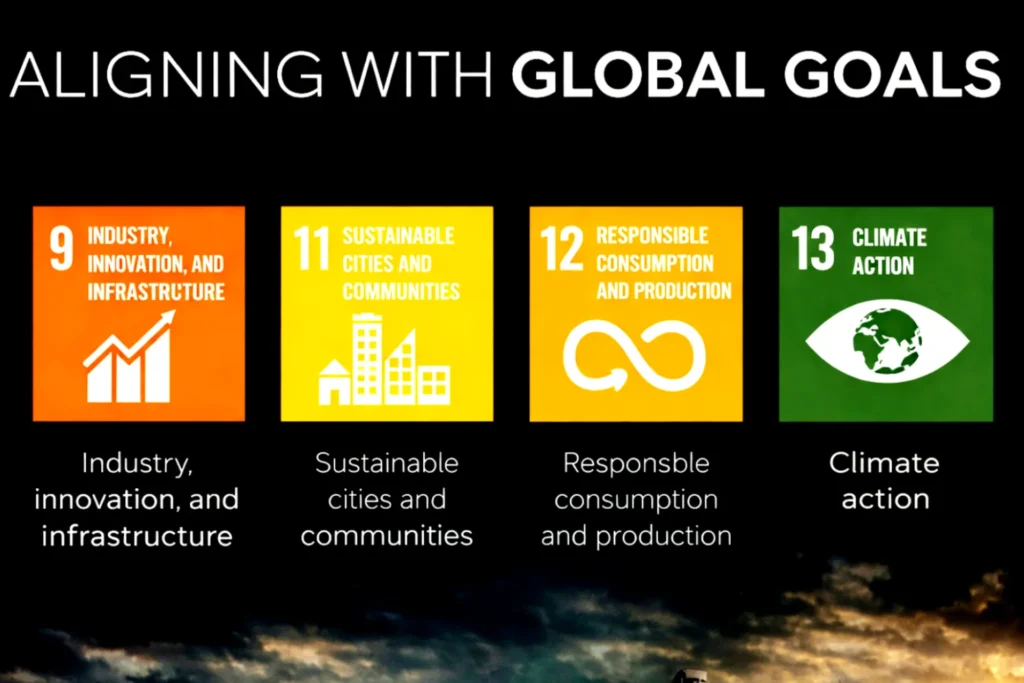
These innovations align with key Sustainable Development Goals (SDGs):
- SDG 9: Industry innovation and infrastructure
- SDG 11: Sustainable cities and communities
- SDG 12: Responsible consumption and production
- SDG 13: Climate action
They support the Paris Agreement’s ambition to limit warming to 1.5°C, which is a threshold the IPCC now estimates has a 67% probability of being breached within six years. The buildings and construction sector accounts for roughly 21% of global greenhouse gas emissions (UNEP, 2024). Every material decision in this sector either compounds that burden or begins to lift it.
However, alignment on paper is not enough. A 2025 UNEP GlobalABC report highlights the absence of standardized methodologies for measuring embodied carbon in buildings across major carbon standards. Without transparent accounting, the risk of greenwashing grows, and the communities least responsible for climate change bear the cost of that ambiguity.
Lifecycle honesty is not optional. It is a justice issue.
A Shift Toward Stewardship
We have spent decades asking: How do we reduce emissions from construction?
That question still matters. But a more ambitious one is now emerging: How do we design materials and systems that actively store carbon while enabling equitable development?
Not carbon-light. Carbon-storing. Not just less harmful. Potentially regenerative.
This shift, from emissions to stewardship, echoes something much older than modern climate frameworks. The built environment is not just infrastructure. It is a trust placed in future generations. What we build, we are responsible for.
Khalifah is not a metaphor. It is a serious obligation.
If you’re working on low-carbon materials, embodied carbon policy, or climate-resilient infrastructure. particularly in South Asia or the Global South, I’d love to connect and exchange ideas!
References
- International Energy Agency (IEA). Cement Technology Roadmap & CCUS in Industry, 2023
- United Nations Environment Programme (UNEP). Global Status Report for Buildings and Construction 2024
- IPCC. AR6 Working Group III — Mitigation of Climate Change, 2022
- Habert, G. et al. Nature Communications — “Carbon dioxide utilization in concrete curing or mixing might not produce a net climate benefit,” 2024
- Dranseike, S. et al. Nature Communications — “Dual carbon sequestration with photosynthetic living materials,” ETH Zurich, 2025
- Fraunhofer IKTS/FEP. BioCarboBeton Project, 2024
- Prometheus Materials / SOM. Bio-Concrete Research Overview, 2024
- GlobalABC / UNOPS. Climate Action Roadmap for Buildings and Construction — Bangladesh, 2024
- India Brand Equity Foundation (IBEF). Green Building Materials Market Report, 2025
- USGBC. Top 10 Countries for LEED Certification 2024
- UNEP GlobalABC. New Report Urges Immediate Action on Embodied Carbon in Building Materials, 2025
- GCCA. Concrete Future Roadmap, 2021