

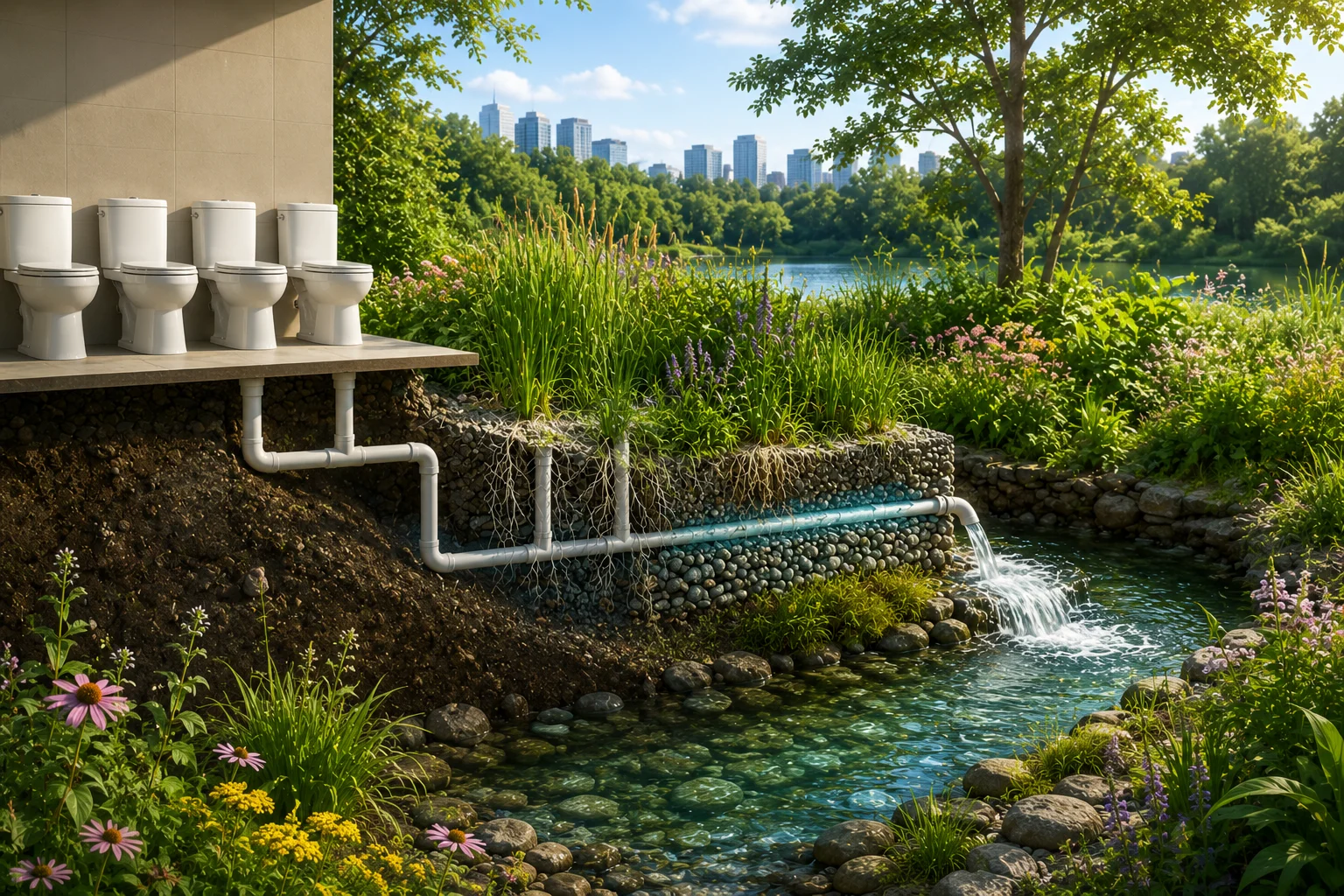
When we talk about Net Zero, we talk about solar, wind, hydrogen, nuclear, and grids.
We almost never talk about sanitation. Yet sanitation quietly shapes public health, emissions, water security, dignity, and climate resilience — particularly in rural regions and climate-vulnerable communities across the Global South. Nearly 80% of global wastewater is still discharged untreated, as per UNEP and the World Bank.
That is not just a sanitation gap. It is a WASH and systems failure — one that no credible Net-Zero pathway can afford to ignore.
Why WASH matters in a Net-Zero world
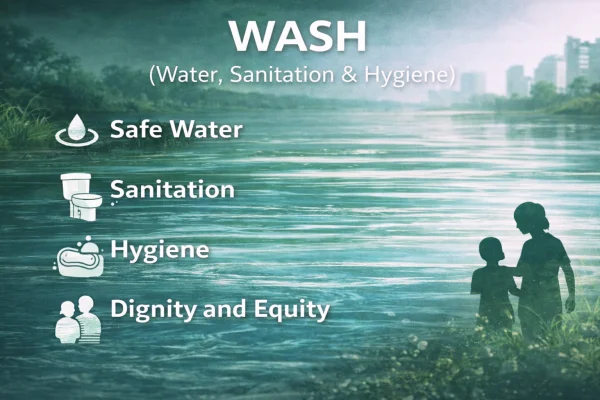
Water, Sanitation, and Hygiene (WASH) are not social add-ons. They are foundational infrastructure for human well-being and sustainable development.
Weak WASH systems:
- Drive waterborne diseases and chronic public-health crises
- Increase methane and nitrous-oxide emissions from untreated wastewater
- Lock communities into energy-intensive and fragile sanitation models
- Deepen inequality, disproportionately affecting children, women, seniors, and marginalized populations
Climate change intensifies these risks through flooding, droughts, contamination, and system failures.
Implementing WASH at the community level — and educating and training youth in WASH techniques — creates long-term, generational impact. When young people understand how to manage safe water, sanitation, and hygiene locally, communities become healthier, more resilient, and more self-reliant. This directly improves sanitation and hygiene outcomes while restoring dignity and equity for those most affected by inadequate infrastructure. Over time, youth-led WASH knowledge reduces disease burden, strengthens public health, and builds a generation capable of sustaining climate-resilient systems — ensuring future development that is not only cleaner, but fairer and more inclusive.
WASH is therefore not only about health. It is about climate adaptation, mitigation, equity, and intergenerational resilience (Fig 1).
What nature-based sanitation really means
Nature-based sanitation applies ecological intelligence instead of brute-force engineering.
It includes:
- Constructed wetlands and reed-bed systems
- Decentralized wastewater treatment (DEWATS)
- Soil–plant–microbe symbiosis
- Anaerobic digestion and composting systems
Wastewater moves slowly through layers of gravel, soil, plant roots, and beneficial microorganisms, where contaminants are naturally filtered and broken down.
No chemicals. Low energy. High resilience.
This is not “low-tech.” It is ecological systems design
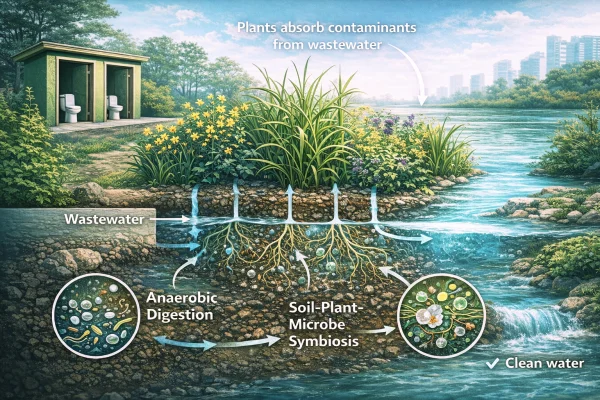
This visual image (Fig 2) is known as nature-based or plant-based wastewater treatment, often implemented through constructed wetlands or decentralized wastewater treatment systems (DEWATS).
Instead of relying on energy-intensive treatment plants, the system uses:
- Plants to absorb nutrients and oxygenate the root zone
- Microorganisms to biologically break down organic pollutants and pathogens
- Soil and gravel to physically filter suspended solids
Anaerobic digestion reduces organic waste, while the soil–plant–microbe interaction further cleans the water as it flows through the system. The process is slow, passive, and highly efficient, requiring minimal energy and maintenance.
The result is treated water that can be reused for irrigation, toilet flushing, groundwater recharge, or safely returned to nature — supporting sanitation, water security, climate resilience, and environmental restoration.
Where this is already working
Nature-based sanitation is not theoretical. It is already delivering results across diverse contexts:
- India – DEWATS systems are serving schools, housing, and institutions
- Bangladesh – Wetland-based sanitation is improving resilience in many flood-prone rural areas and communities
- Kenya & Rwanda – Eco-sanitation and constructed wetlands for schools and hospitals
- Latin America – Constructed wetlands are supporting rural and peri-urban settlements
- Europe – Nature-based wastewater treatment and reuse are being integrated into sustainable urban planning
Different regions. Different constraints. Same principle: design with nature, not against it.
From wastewater to resource: reuse and circularity
Once treated through nature-based systems, wastewater becomes a valuable resource.
Proven reuse pathways include:
- Irrigation for agriculture, parks, and urban greenery
- Toilet flushing and non-potable building use
- Groundwater recharge
- Safe environmental discharge supporting ecosystems
- Urban cooling and green infrastructure
This is circular water in practice — reducing freshwater demand, lowering emissions, and increasing resilience. Net Zero is not only about clean energy. It is about closing material and water loops.
What this means for policy, planning, and youth-centered development
Nature-based sanitation and WASH directly support:
- SDG 6 – Clean Water and Sanitation
- SDG 11 – Sustainable Cities and Communities
- SDG 12 – Responsible Consumption and Production
- SDG 13 – Climate Action
They offer a pathway toward:
- Climate-resilient infrastructure
- Nature-positive development
- Inclusive, youth-centered planning
- Community-owned solutions that endure
Sanitation is not a “developing world issue.” It is a future-ready infrastructure choice.
A final thought
Wastewater is not waste. It is mismanaged water. When treated through nature and supported by strong WASH education at the community level — sanitation systems do more than just protect health and well-being. They restore dignity, reduce emissions, build community and environmental resilience, and empower the next generation.
Nature already knows how to clean water. Our responsibility is to design our systems — and educate our youth accordingly.
References & further reading
- UN-Water – Wastewater: The Untapped Resource
- WHO & UN-Habitat – Decentralized Wastewater Treatment Systems
- WaterAid – WASH and Constructed Wetlands
- IUCN – Nature-Based Solutions for Water Management
- FAO – Wastewater Reuse in Agriculture
- World Bank – Nature-Based Solutions for Climate Resilience