


How Small-Scale Systems Can Create Jobs, Build Resilience, and Accelerate Net Zero Across Different Climates
For decades, solar energy has been framed as a solution best suited to sunny, temperate regions. Yet mounting evidence from cold climates in North America, desert-scale deployment in the Middle East, and pilot projects across developing economies tells a different story:
Solar photovoltaics work efficiently in extreme environments—when they are designed intentionally.
As solar technology costs fall rapidly and efficiencies improve, a new opportunity is emerging: small-scale, winter-resilient solar systems that function not only as clean energy assets, but as economic infrastructure, job creators, and social development tools.
This is not about replicating gigawatt-scale desert projects everywhere. It is about adapting proven design principles to local conditions and deploying them at human scale—in communities, campuses, markets, hospitals, and public spaces.
Why Solar Works in Winter (When Designed Right)
Research and field experience across Canada and the northern United States consistently show that photovoltaic modules perform more efficiently in cold temperatures than in extreme heat. The true challenges in winter climates are not technological, but contextual:
- Snow accumulation
- Shorter daylight hours
- Evening demand peaks
- Grid stress during extreme weather
These challenges are increasingly addressed through design choices, not new technology:
- Steeper tilt or vertical panel configurations to shed snow
- Bifacial panels that capture reflected light from snow-covered ground (high albedo)
- Elevated racking and carports that reduce snow burial and simplify maintenance
- Integration with battery storage, smart controls, and microgrids
Across North America, these approaches are already supporting small-scale, resilient systems in municipal facilities, campuses, and remote communities—reducing diesel dependence, improving reliability, and lowering long-term operating costs.
What North America Can Scale Next
Treat Solar as Infrastructure, Not Just Generation
In Canada and the United States, the next phase of solar expansion is less about proving feasibility and more about deployment strategy.
Small-scale, distributed solar can be rapidly expanded through:
- Solar carports over parking lots
- Rooftop PV on hospitals, universities, and office buildings
- Community solar paired with neighborhood batteries
- Campus and municipal microgrids
These assets:
- Avoid land-use conflicts
- Align naturally with existing electricity demand
- Are easier to permit and maintain in winter conditions
Job Creation and Workforce Development
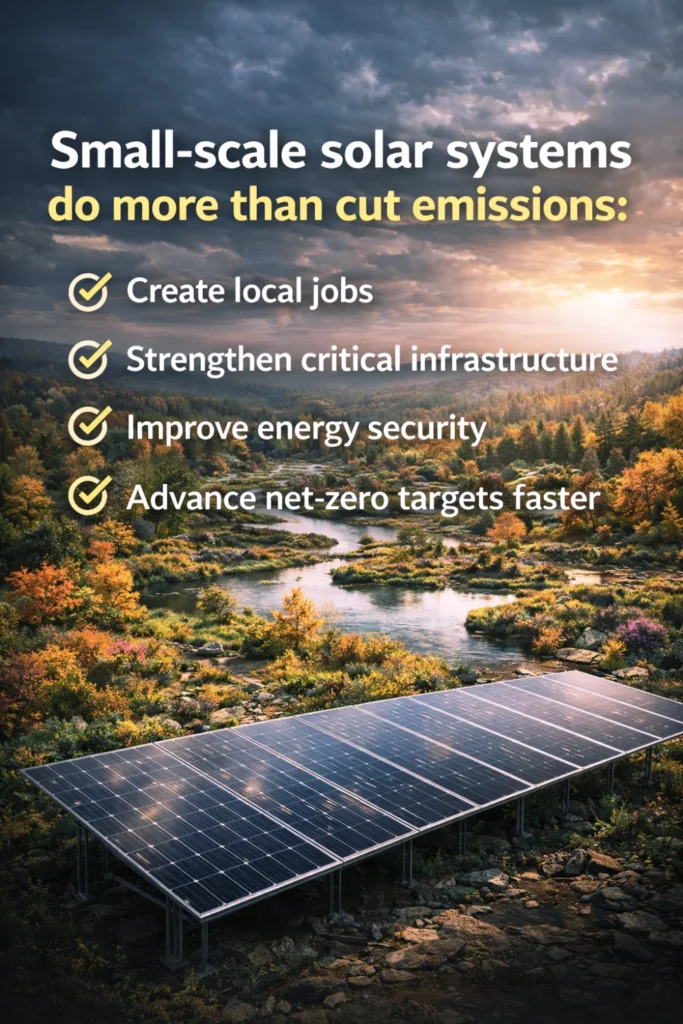
Small-scale solar creates more jobs per megawatt than utility-scale projects. These include:
- Installers and electricians
- Operations and maintenance technicians
- Energy auditors and system designers
- Battery and microgrid specialists
With intentional training pathways, these projects can support:
- Youth employment
- Immigrant workforce integration
- Women’s participation in clean-energy trades
In this sense, energy policy becomes labor policy—by design rather than accident.
What Asian and Developing Countries Can Adopt (Small, Smart, and Scalable)
Many Asian and developing economies—particularly across South Asia, Southeast Asia, Central Asia, and parts of Africa—face common structural pressures:
- High unemployment, especially among youth
- Energy access gaps and unreliable grids
- Rapid urbanization stressing infrastructure
- Acute climate vulnerability
For these regions, small-scale solar pilots represent a low-risk, high-return entry point into the energy transition.
Unlike mega-projects, small systems:
- Require lower upfront capital
- Can be deployed incrementally
- Deliver visible local benefits quickly
- Allow learning and adaptation before scaling
Practical Pilot Models
1. Community Solar + Storage Ideal for villages, informal settlements, and weak-grid areas, these systems improve reliability, reduce diesel use, and enable evening economic activity.
Learning: Energy access is most effective when it is shared, locally governed, and paired with storage.
2. Solar Carports at Markets, Hospitals & Universities Carports avoid land conflicts, provide shade, match daytime demand, and offer high public visibility—making them ideal early wins.
Learning: Start where land already exists and public value is immediate.
3. Microgrids for Industrial Parks & Public Facilities Microgrids protect productivity, reduce outage risk, and serve as training grounds for engineers and technicians.
Learning: Reliability is as valuable as capacity for economic growth.
4. Agrivoltaics for Farmers Co-locating solar with agriculture increases land efficiency, diversifies income, reduces water loss, and stabilizes rural livelihoods.
Learning: Transitions succeed faster when they add value to existing livelihoods.
Why Cost Is No Longer the Main Barrier
With global solar module prices falling sharply and efficiencies improving, technology cost is no longer the binding constraint.
The real sources of value now lie in:
- Workforce training and certification
- Local manufacturing, assembly, and maintenance
- Institutional capacity to plan, procure, and regulate
- Gender-inclusive and socially intentional program design
Solar hardware has become a commodity. Human capital is the competitive advantage.
Learning from the Middle East—Without Copying Blindly
Large-scale projects in Saudi Arabia, the UAE, and the Gulf demonstrate what is possible when:
- Procurement is streamlined
- Financing is long-term
- Scale is used deliberately to drive down cost
However, the most transferable lessons for North America and Asia are not about size, but about:
- Policy clarity
- Predictable regulatory frameworks
- Execution discipline
The Middle East proves renewables can thrive in extreme heat and arid conditions. Cold regions prove renewables can thrive in winter and low-light conditions.
Small-scale systems are where these lessons converge—combining robustness, adaptability, and social acceptance.
SDG Alignment: One Intervention, Many Outcomes
Winter-resilient, small-scale solar advances multiple Sustainable Development Goals simultaneously:
- SDG 7 – Affordable & Clean Energy
- SDG 8 – Decent Work & Economic Growth
- SDG 9 – Industry, Innovation & Infrastructure
- SDG 11 – Sustainable Cities & Communities
- SDG 13 – Climate Action
- SDG 5 – Gender Equality (when workforce programs are inclusive)
Few climate solutions deliver this level of policy leverage per dollar invested.
Final Thought
Net zero will not be achieved through mega-projects alone. It will be built through thousands of small, well-designed, locally owned systems— systems that create jobs, strengthen communities through climate adaptation and mitigation measures, and earn public trust. Winter-resilient solar is not a limitation. It is a design challenge, a development opportunity, and a systems solution hiding in plain sight.
Top Ten References (Most Influential)
- National Renewable Energy Laboratory — Cold-climate PV performance & bifacial design
- Natural Resources Canada — Distributed solar in Canadian winter conditions
- International Energy Agency — Distributed energy & system resilience
- U.S. Department of Energy — Community & distributed solar programs
- Rocky Mountain Institute — Economics of solar + storage
- International Labour Organization — Jobs and inclusive growth
- International Renewable Energy Agency — Innovation, jobs, and GCC lessons
- Lazard — Levelized Cost of Energy (solar competitiveness)
- BloombergNEF — Global PV cost and efficiency trends
- United Nations — SDG alignment (energy, jobs, infrastructure, climate)